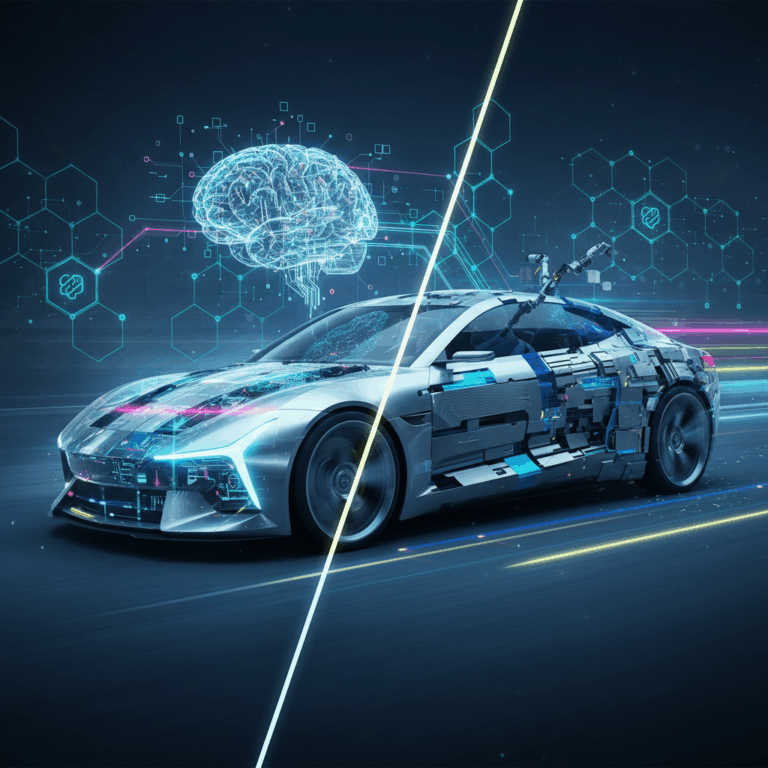
Technological Advances Driving Change
The automotive industry is undergoing a significant transformation due to technological advances. Innovations like artificial intelligence and 3D printing are central to this rapid evolution.
These technologies enhance production efficiency, reduce costs, and improve vehicle safety and customization, reshaping how cars are designed and built across the sector.
Artificial Intelligence in Production and Safety
Artificial intelligence is revolutionizing automotive manufacturing by automating complex tasks and optimizing production lines. This leads to fewer errors and increased speed in assembly processes.
Beyond the factory, AI supports the development of autonomous and electric vehicles by integrating intelligent safety systems. These systems enhance driver assistance and overall road safety.
Moreover, AI-driven simulations improve vehicle design and testing, enabling manufacturers to create safer and more efficient models without relying solely on physical prototypes.
3D Printing for Customization and Rapid Manufacturing
3D printing offers the automotive industry a flexible manufacturing solution, allowing rapid production of parts and components on demand. This reduces supply chain lead times significantly.
Customization becomes easier and more cost-effective, as 3D printing supports tailored components that meet specific customer needs or prototype requirements.
This technology also fosters innovation during vehicle development by enabling small-scale series and prototypes, accelerating time-to-market for new models.
Blockchain Transforming Supply Chain and Transactions
Blockchain technology is significantly enhancing the automotive supply chain by introducing unprecedented levels of data security and transparency. This innovation ensures that all parties can trust the accuracy and integrity of shared information.
By decentralizing data, blockchain minimizes risks of fraud and data tampering, facilitating safer transactions between manufacturers, suppliers, and customers. Its adoption is leading to more efficient, trustworthy supply chain management.
Data Security and Transparency in Automotive Supply Chains
Blockchain provides a secure ledger system that records every transaction and movement within the supply chain. This transparency reduces errors and promotes accountability among stakeholders.
As data is immutable once recorded, blockchain helps detect counterfeit parts and unauthorized alterations, thus protecting the integrity of vehicle components from manufacturing to delivery.
The decentralized nature of blockchain means no single party controls the data, enhancing trust and collaboration across different supply chain entities globally.
Enhancing Trust and New Business Models
Blockchain fosters enhanced trust among participants by providing verifiable records of ownership and transactions. This trust enables innovative business models like shared mobility and subscription services.
Seamless smart contracts automate payments and agreements, reducing administrative overhead and accelerating business operations within the automotive ecosystem.
These new models supported by blockchain improve flexibility and customer experience by enabling transparent and efficient usage-based ownership and service schemes.
Traceability and Authenticity of Parts
One key blockchain benefit is the ability to ensure full traceability and authenticity of automotive parts from production to installation. Each component is tagged with a unique digital identity on the blockchain.
This traceability guards against counterfeit parts entering the market, enhances warranty and recall processes, and builds consumer confidence in vehicle safety and quality.
Interesting Fact
Some automakers are piloting blockchain platforms that allow consumers to verify the entire history of a vehicle’s parts, offering transparency that directly impacts resale value and maintenance trustworthiness.
Impacts on Vehicle Development and User Experience
The integration of AI in vehicle development is revolutionizing how cars are designed, tested, and experienced. Autonomous and electric vehicles are at the forefront of this innovation.
This shift brings smarter, safer vehicles while dramatically enhancing user experience through advanced assistance systems and customization options.
AI-Driven Autonomous and Electric Vehicles
Artificial intelligence powers autonomous vehicles by enabling complex decision-making in real-time, improving safety and convenience. Electric vehicles gain efficiency through AI-optimized energy management.
AI integrates sensors and data to continuously learn driving patterns, adapting to environments and reducing human error. This advancement pushes the automotive sector toward fully automated mobility solutions.
Furthermore, AI supports the development of sustainable electric powertrains, enhancing battery life and optimizing charging. Users enjoy smarter, eco-friendly cars that meet modern demands.
Simulation and Testing with AI
AI-driven simulation tools significantly accelerate vehicle testing by creating virtual environments to assess performance and safety. This reduces costs and development time without compromising quality.
Complex scenarios, including rare or dangerous conditions, can be safely replicated, allowing better preparation of autonomous systems and driver assistance technologies before real-world deployment.
AI simulations also facilitate iterative design improvements, helping engineers identify flaws early and refining vehicle dynamics and system integration efficiently.
Industry-wide Digital Transformation
The automotive industry is experiencing a sweeping digital transformation driven by the integration of advanced technologies. This shift enhances operational efficiency and innovation.
Digital tools and strategies are being adopted across the value chain, leading to smarter manufacturing, improved connectivity, and personalized customer experiences in the automotive sector.
Integration of Technologies for Efficiency
Combining AI, blockchain, and 3D printing boosts efficiency by streamlining production and supply chain processes in automotive manufacturing.
This integration enables faster decision-making, reduces costs, and improves quality through real-time data sharing and automated workflows.
Manufacturers benefit from more responsive logistics and resource management, which leads to minimized waste and accelerated vehicle development cycles.
Towards a Connected and Personalized Automotive Sector
The digital transformation fosters a connected automotive ecosystem, where vehicles and services are tailored to individual user needs.
Advanced data analytics and AI enable personalized vehicle features, adaptive user interfaces, and predictive maintenance, enhancing customer satisfaction.
This connectivity extends beyond cars to incorporate smart infrastructure and mobility services, driving a more user-centric and seamless driving experience.