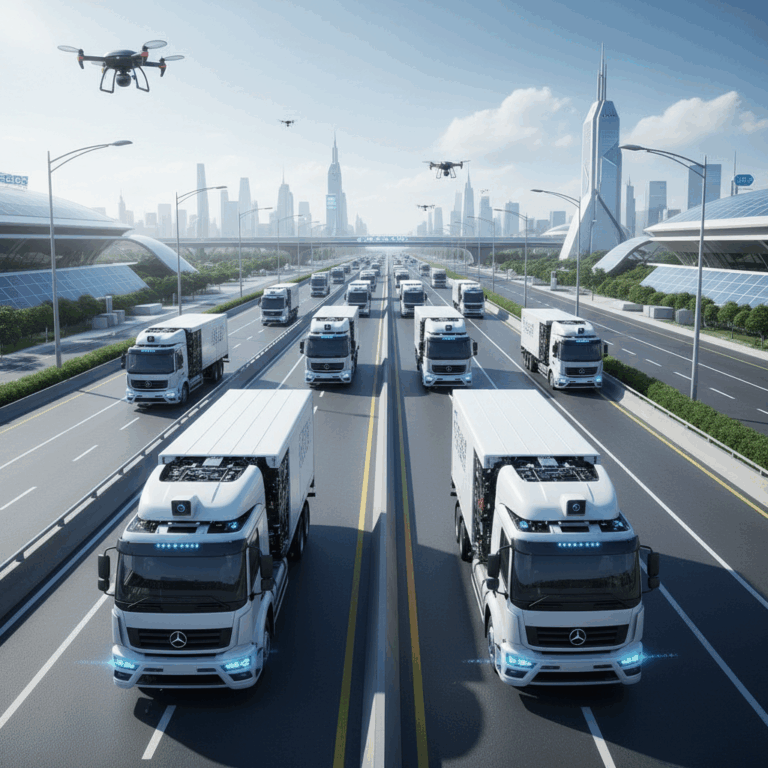
Technologies Behind Autonomous Trucks
Autonomous trucks rely on a blend of cutting-edge technologies to operate without human intervention. These include sensors, cameras, radar systems, and artificial intelligence that enable precise navigation and control.
These technologies work together to ensure real-time perception and decision-making, allowing trucks to respond swiftly to road conditions, obstacles, and traffic scenarios.
By integrating these systems, autonomous trucks can maintain continuous operation, increase efficiency, and enhance safety on the roads.
Advanced Sensors, Cameras, and Radar Systems
Advanced sensors form the foundational layer of autonomous trucks, providing a detailed understanding of the environment around the vehicle. These include LIDAR, radar, ultrasonic sensors, and high-resolution cameras.
Radar systems help detect objects at long distances in various weather conditions, while cameras capture visual information for lane detection, traffic signals, and obstacle avoidance.
Combined with sensor fusion techniques, these devices generate a comprehensive environmental map, ensuring the truck can safely navigate complex traffic scenarios and adapt to sudden changes.
These sensing systems allow autonomous trucks to operate day and night, offering a significant advantage over human drivers who may suffer from fatigue.
Artificial Intelligence and Automated Decision Making
Artificial intelligence is at the core of autonomous trucks’ ability to make informed, split-second decisions. Machine learning algorithms process sensor data to understand road conditions and predict other road users’ behaviors.
These AI systems enable the truck to plan routes, control speed, and execute maneuvers such as lane changes or emergency braking automatically.
Continuous learning from vast amounts of driving data improves the system’s performance over time, enhancing safety and operational efficiency.
Integration of AI with Safety Protocols
AI in autonomous trucks is designed with strict safety protocols, including fail-safes and redundancy, to handle unexpected scenarios and maintain control in critical situations.
Benefits and Operational Advantages
Autonomous trucks offer significant benefits that transform freight transport, driving increased efficiency and operational advantages across the logistics industry.
These vehicles enable continuous operation without the need for driver rest periods, optimizing fleet productivity and reducing overall transport time.
Additionally, autonomous trucks contribute to improved safety and environmental outcomes, creating a more sustainable and reliable logistics ecosystem.
Increased Efficiency and Continuous Operation
Without human fatigue constraints, autonomous trucks can operate 24/7, drastically increasing cargo throughput and reducing delays linked to driver hours limits.
This continuous operation capability enhances supply chain responsiveness, shortening delivery times and improving fulfillment rates.
Furthermore, automation minimizes human errors and optimizes driving strategies like speed and route selection, leading to fuel savings and cost reductions.
Improved Road Safety and Accident Reduction
Autonomous trucks utilize advanced sensors and AI to detect hazards and react faster than human drivers, significantly lowering accident risks caused by human error.
Automated systems maintain optimal following distances and avoid risky maneuvers, contributing to safer traffic conditions for all road users.
This technology has the potential to reduce collisions, injuries, and fatalities, fostering public confidence in freight transport safety.
Environmental Impact and Emission Reductions
Efficient driving patterns enabled by autonomous trucks reduce fuel consumption and emissions by optimizing speed, acceleration, and braking behavior.
Continuous operation also allows for better route planning and load management, further decreasing the environmental footprint of freight transport.
These eco-friendly benefits align with global goals to reduce greenhouse gases and promote sustainable transportation solutions.
Current Deployment and Challenges
Autonomous trucks are gradually being integrated into commercial fleets worldwide, with pilot programs testing their capabilities in real-world settings. These initiatives help refine technology and showcase potential benefits.
Despite promising advances, deployment is still limited and often requires human supervision to ensure safety and compliance with regulations during trials.
The transition to fully autonomous trucking faces significant challenges, including technical limitations, infrastructure readiness, and evolving legal frameworks across regions.
Commercial Use and Pilot Programs Worldwide
In the United States and China, autonomous trucks have entered commercial operations, often transporting goods on highways with varying levels of automation and human oversight.
Europe and other regions are conducting extensive pilot programs, aiming to gather data, optimize systems, and prepare for broader deployment of self-driving freight vehicles.
These pilots focus on middle-distance routes where technology maturity enables safe and efficient operation, setting the foundation for future expansion.
Regulatory, Technological, and Infrastructure Barriers
Regulatory environments vary globally, with many countries adapting laws slowly to accommodate the unique aspects of autonomous trucks, including liability and safety standards.
Technological hurdles such as sensor reliability in adverse weather and complex urban scenarios remain critical challenges to fully unsupervised operation.
Existing infrastructure often lacks necessary support, including connected roadways and consistent communication networks, limiting the efficiency and safety of autonomous systems.
Future Implications for Freight Transport
The advent of autonomous trucks will profoundly alter the landscape of freight transport, influencing how logistics networks and infrastructure are designed. Anticipated changes will enhance operational efficiency and reshape supply chains.
As autonomous trucks become more prevalent, infrastructure must evolve to support their unique requirements, including dedicated lanes, smart traffic management, and advanced charging or fueling stations.
This transition supports the creation of more resilient and adaptive logistics systems, facilitating continuous freight movement with fewer delays and reduced dependence on human factors.
Changes in Logistics and Infrastructure Planning
Logistics planning will shift towards accommodating 24/7 autonomous truck operations, allowing for more flexible delivery schedules and dynamic route optimization. Supply chains will become faster and more reliable.
Infrastructure development will focus on integrating technology such as IoT sensors, high-speed communication networks, and automated loading docks, all designed to support autonomous fleet management.
Future freight hubs and distribution centers may be reimagined to maximize efficiency, reducing turnaround times and streamlining cargo handling in sync with autonomous vehicle capabilities.
Enhanced connectivity between trucks and infrastructure will enable real-time data exchange, improving traffic flow and safety throughout transport corridors.
Impact on Employment and Workforce Dynamics
The rise of autonomous trucks will inevitably transform the workforce, reducing demand for traditional truck drivers but creating new roles in vehicle monitoring, maintenance, and system oversight.
While autonomous technology may displace some driving jobs, it will also open opportunities in higher-skilled positions related to fleet management, software development, and cybersecurity.
Workforce adaptation and retraining programs will be essential to help employees transition to new roles, ensuring a balanced integration of human expertise with automated systems.
Ultimately, autonomous trucks will complement human work rather than fully replace it, promoting collaboration between humans and machines in freight transport operations.