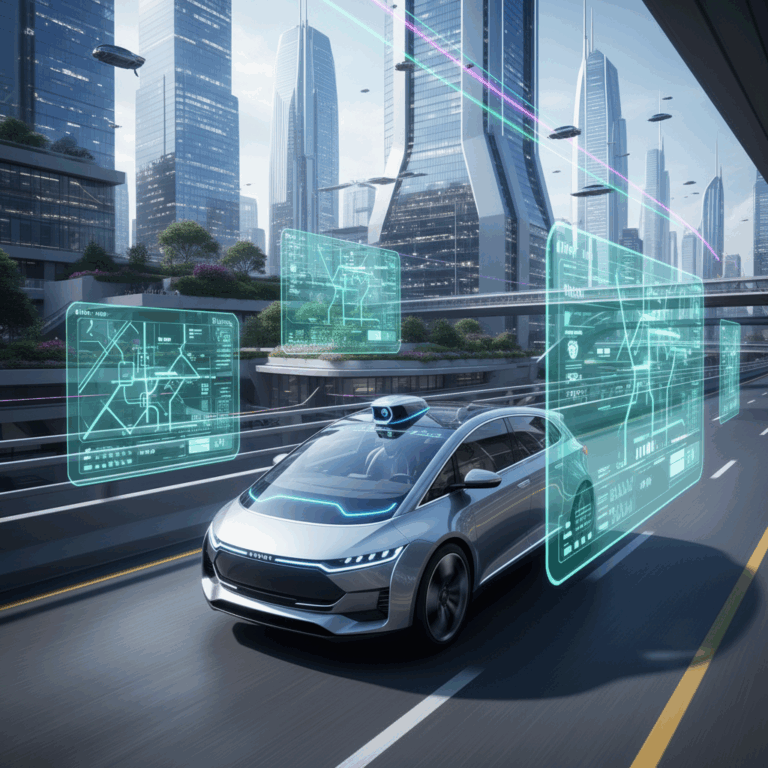
Safety Improvements with Autonomous Vehicles
Autonomous vehicles are revolutionizing road safety by integrating advanced sensor systems and AI technology. These innovations enable cars to perceive their surroundings and make critical decisions instantly.
With real-time processing, autonomous cars can anticipate hazards more effectively than human drivers, significantly reducing the risk of collisions and enhancing overall safety on the roads.
By minimizing human error, which accounts for over 90% of traffic accidents, these vehicles offer a transformative approach to safer driving experiences worldwide.
Sensor and AI Technologies Enabling Real-Time Decision Making
Equipped with LiDAR, radar, cameras, and sophisticated AI algorithms, autonomous cars continuously scan their environment. This adaptability allows immediate response to dynamic road conditions.
AI processes vast data streams instantaneously to identify obstacles, pedestrians, and traffic signals, ensuring accurate and timely maneuvering in complex scenarios.
This fusion of sensor inputs and machine learning allows vehicles to operate safely even in situations demanding split-second judgments without human intervention.
These technologies collectively support seamless navigation and minimize risks, establishing a new benchmark for vehicle intelligence.
Reduction of Human Error and Accident Rates
Human error contributes to the vast majority of traffic accidents. Autonomous vehicles dramatically reduce these risks by eliminating distractions, fatigue, and impaired judgment.
Advanced control systems consistently adhere to traffic laws and react predictably, decreasing dangerous behaviors like sudden braking or speeding.
Real-world data from leading autonomous vehicle trials demonstrate substantial drops in accidents, proving the potential of this technology to save thousands of lives annually.
Efficiency and Environmental Impact
Autonomous vehicles offer significant improvements in traffic management by optimizing flow and reducing congestion. Their ability to communicate with each other helps minimize delays on busy roads.
Efficient routing and coordinated speeds contribute to smoother traffic patterns, leading to less time wasted in jams and lower fuel consumption across urban areas.
These advancements are key to reducing the environmental footprint of transportation and promoting more sustainable city living.
Traffic Flow Optimization and Congestion Reduction
Through vehicle-to-vehicle communication, autonomous cars synchronize their movements, preventing stop-and-go traffic and reducing bottlenecks on highways.
This smooth traffic flow reduces idle times and emissions, contributing to cleaner air and less noise pollution in urban environments.
Overall, autonomous technology fosters more predictable and stable traffic conditions, improving the daily commute for all road users.
Environmental Benefits and Sustainable Urban Living
By decreasing congestion and optimizing driving patterns, autonomous vehicles lower carbon emissions, playing a crucial role in combating climate change.
These vehicles promote sustainable urban development by encouraging shared mobility models and reducing the need for extensive parking infrastructure.
Consequently, cities become greener, quieter, and healthier places where residents enjoy improved air quality and reduced environmental stress.
Enhanced Productivity Through Time Reallocation
Self-driving cars transform travel time into usable hours, allowing passengers to focus on work, leisure, or rest instead of steering the vehicle.
This shift boosts productivity and personal well-being by freeing people from the demands of driving and traffic-related stress.
Ultimately, autonomous vehicles redefine commuting as an opportunity rather than a chore, enhancing quality of life across the board.
Accessibility and Social Inclusion
Autonomous cars are paving the way for greater mobility and independence among people with disabilities. These vehicles remove many physical barriers associated with traditional driving.
By enabling safe, self-driven travel, autonomous cars allow individuals with limited mobility to access transportation without relying on others, enhancing their freedom and social participation.
Increased Mobility for People with Disabilities
People with physical or cognitive impairments often face significant challenges using traditional vehicles. Autonomous cars offer intuitive interfaces and adaptive features tailored to their needs.
This technology helps eliminate the need for a driver’s license or manual vehicle operation, opening new opportunities for employment, education, and social engagement.
Moreover, autonomous vehicles can be equipped with specialized accessibility tools, such as voice commands and wheelchair-friendly designs, further promoting inclusivity.
These advances democratize transportation, fostering a more equitable society where everyone can enjoy the benefits of mobility.
Industry Progress and Future Challenges
Leading companies such as Tesla, Waymo, and Ford have made remarkable advancements in autonomous vehicle technology, showcasing their vehicles’ ability to travel millions of miles with few to no accidents.
These extensive real-world tests provide invaluable data, boosting public confidence and proving the viability of autonomous cars to transform road safety and transportation efficiency.
Advancements by Leading Companies and Real-World Testing
Major industry players continuously refine AI systems, sensor precision, and vehicle hardware, ensuring autonomous vehicles perform reliably in diverse environments and weather conditions.
Real-world deployments involve complex urban and highway scenarios, pushing vehicles to adapt and learn, which accelerates overall technological maturity and durability.
Continuous software updates and fleet data collection contribute to faster improvements and enhanced safety, fueling innovation cycles in the sector.
Regulatory, Social, and Technological Hurdles
Despite progress, autonomous vehicles face significant regulatory challenges, as lawmakers must establish comprehensive policies addressing safety standards and liability issues.
Social acceptance remains critical; public trust hinges on transparent communication about risks, security, and ethical considerations around autonomous technology.
Technologically, issues such as cybersecurity, system failures, and interoperability require ongoing research to ensure safe, reliable, and scalable deployment of self-driving cars.